

Braces before and after photos are everywhere, and they usually show the same story: crowded or uneven teeth on the left, a neat, even smile on the right. What a photo cannot show is the two years in between, the sore days after each adjustment, or what happens to the result once the braces come off. This guide explains what braces before and after really involves, what changes and what does not, and how to read the photos you see online so you know what to expect for your own teeth.
Before: what happens at the start of treatment
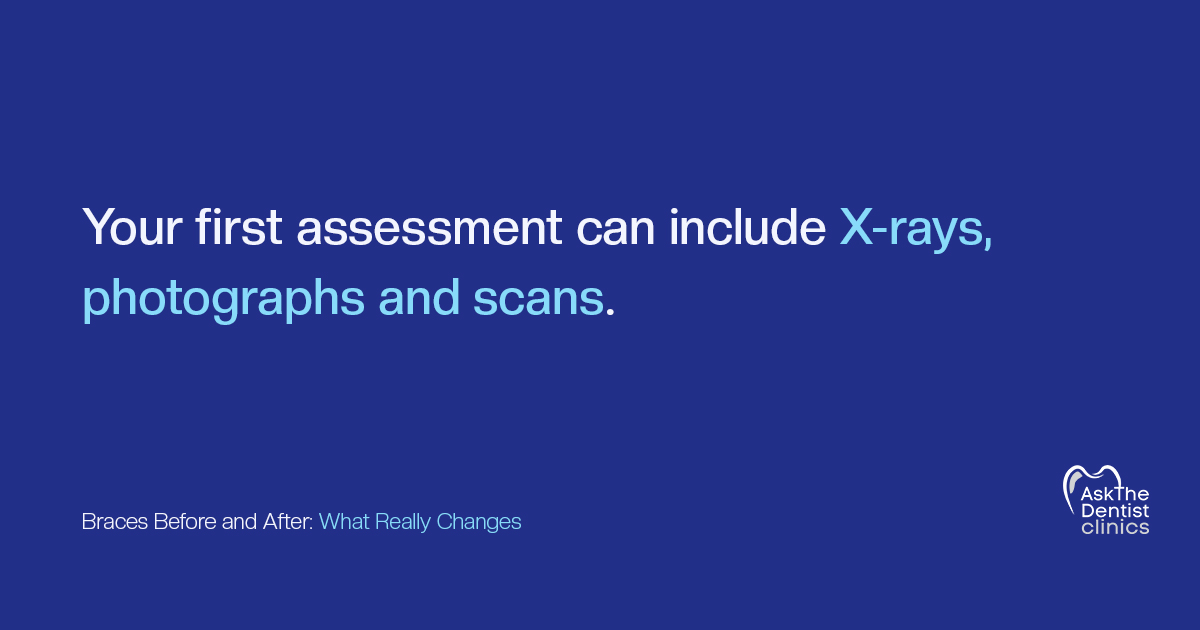
Treatment begins with an assessment. The NHS says this may include examining the teeth and jaws and taking X-rays, photographs or scans [1]. These records are the real “before” picture, because they give the orthodontist a baseline to plan from and to compare against later.
The British Orthodontic Society says patients should be told about the benefits, the expected duration, what will and will not be achieved, the alternatives and the consequences of having no treatment [2]. Ask for that conversation if it does not happen on its own.
There are also conditions to meet first. An NHS trust leaflet says treatment will not begin unless you have an excellent standard of oral hygiene, because orthodontic treatment can increase the risk of tooth decay and gum problems [10]. Active gum disease must be treated and stabilised before braces go on [2].
During: how teeth change month by month
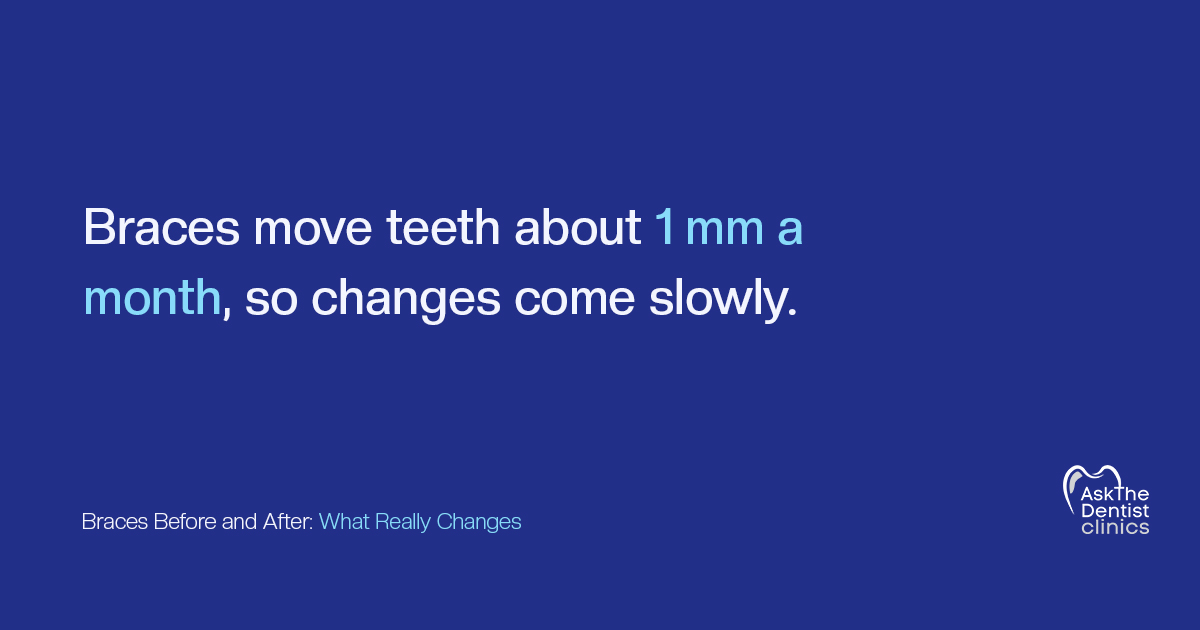
The changes come slowly. Nottingham University Hospitals NHS Trust reports that teeth move at roughly 1 mm per month, because the jaw bone around each tooth has to remodel [3]. Most orthodontic treatment takes 18 months to two years, and more complex cases average two and a half to three years [3]. Appointments usually come every 6 to 8 weeks [1].
The early weeks are the hardest. The British Orthodontic Society’s patient leaflet says teeth are likely to be sore for about 3 to 5 days after the braces are fitted and after each adjustment [4]. A questionnaire survey of 75 patients with fixed braces at the Lagos University Teaching Hospital found that about 73% had difficulty eating, 65.8% had difficulty cleaning their teeth, and 64% said they had wanted to stop treatment at some point [5]. Those numbers do not mean treatment goes badly. They mean the in-between stage is hard for many people, and it helps to expect it.
After: what braces before and after results can show
The NHS says braces may be needed when teeth are growing too close together or stick out, when the upper and lower jaws do not meet properly, or when there are large gaps between the teeth [1]. In a good braces before and after comparison, you will usually see straighter teeth, closed or reduced spaces and a more even bite.
Some changes show up in the photos, and some do not. White spots are an example of something that can appear in an “after” photo if cleaning was poor. The British Orthodontic Society lists demineralisation and caries as common risks of orthodontic treatment [2]. A 2025 meta-analysis found that about 55% of people wearing braces developed white spot lesions, compared with about 29% of people with no treatment, and that the risk rose the longer treatment lasted [6]. Careful brushing around the brackets every day is the best protection.
Other changes happen out of sight. The British Orthodontic Society says mild shortening of the root tips occurs in all patients but is insignificant in most cases, and that extensive shortening is rare [2]. Your orthodontist will not be able to show you that in a photo.
What braces before and after photos cannot change
Braces move teeth, and they cannot reshape the jaws. If the bones of the face and jaws are out of balance with each other, orthodontics alone cannot position the teeth to create a functioning bite [7]. Where the jaws are out of balance, treatment can combine orthodontics with jaw surgery [7]. This is one reason a consultation matters more than any photo gallery: whether your case looks like someone else’s depends on your bite, not just how your teeth look from the front.
Why the “after” can change: retainers
The most overlooked part of braces before and after is what happens next. The Cochrane review of retention states that teeth can become crooked again after being straightened with braces, which is called relapse [8]. The British Orthodontic Society says relapse will occur after treatment and that retention is needed in most cases [2]. Its patient leaflet is direct: the only way to ensure your teeth cannot move is to wear your retainers part time for life [9].
That means the “after” photo is a snapshot of the day the braces came off. Whether it still looks the same years later depends partly on whether the retainers are worn as advised.
How to read braces before and after photos
Here are a few questions worth asking whenever you look at a gallery. These are practical suggestions, not clinical rules.
- Are the photos taken from the same angle and in the same light, or does the “after” look better because the camera changed?
- Are they the clinic’s own patients, and can the clinic say how long each treatment took?
- Do the cases look like yours, such as a similar type of crowding or bite?
- Were the patients still wearing retainers when the “after” picture was taken?
- Does anything promise a fixed number of months? The British Orthodontic Society warns that an estimate of treatment time may not always be accurate, because of individual biology, breakages or missed appointments [2].
Book a consultation
The most useful “before” picture you can get is your own. Ask The Dentist in Ibadan offers orthodontic treatment, including metallic braces and clear aligners. Book a consultation to have your teeth and bite assessed and to find out what a realistic “after” looks like for you. For the full picture of how braces work and who can have them, read our guide to braces on teeth.
References
- NHS. Braces [Internet]. [cited 2026 Oct]. Available from: https://www.nhs.uk/tests-and-treatments/braces/
- British Orthodontic Society. Risks of orthodontic treatment: guidance on informing patients [Internet]. 2024 [cited 2026 Oct]. Available from: https://bos.org.uk/wp-content/uploads/2024/12/RISKS-OF-ORTHODONTIC-TREATMENT-GUIDANCE-ON-INFORMING-PATIENTS-2024.pdf
- Nottingham University Hospitals NHS Trust. Fixed appliances [Internet]. [cited 2026 Oct]. Available from: https://www.nuh.nhs.uk/orthodontics-fixed-appliances/
- British Orthodontic Society. Risks of orthodontic treatment: patient information leaflet [Internet]. [cited 2026 Oct]. Available from: https://archive.bos.org.uk/Portals/0/Public/docs/PILs/risksmay09.pdf
- Utomi IL. Challenges and motivating factors of treatment among orthodontic patients. Afr J Med Med Sci. 2007 [Internet]. [cited 2026 Oct]. Available from: https://ir.unilag.edu.ng/items/20264d14-8e4e-460a-a496-69d5d69db6b8
- Hussain U, Wahab A, Kamran MA, Alnazeh AA, Almoammar S, Alshahrani SSM, et al. Prevalence, incidence and risk factors of white spot lesions associated with orthodontic treatment: a systematic review and meta-analysis. Orthod Craniofac Res. 2025;28(2):379-399. https://doi.org/10.1111/ocr.12888
- East Sussex Healthcare NHS Trust. Orthodontics and Jaw Surgery [Internet]. [cited 2026 Oct]. Available from: https://www.esht.nhs.uk/wp-content/uploads/2017/06/0231.pdf
- Martin C, Littlewood SJ, Millett DT, Doubleday B, Bearn D, Worthington HV, Limones A. Retention procedures for stabilising tooth position after treatment with orthodontic braces. Cochrane Database Syst Rev. 2023;CD002283.pub5. https://www.cochranelibrary.com/cdsr/doi/10.1002/14651858.CD002283.pub5/full
- British Orthodontic Society. Retainers [Internet]. 2019 [cited 2026 Oct]. Available from: https://bos.org.uk/wp-content/uploads/2022/03/British-Orthodontic-Society-RetainersFebruary2019.pdf
- Royal Cornwall Hospitals NHS Trust. Orthodontic patient information leaflet [Internet]. [cited 2026 Oct]. Available from: https://doclibrary-rcht.cornwall.nhs.uk/GET/d10368869